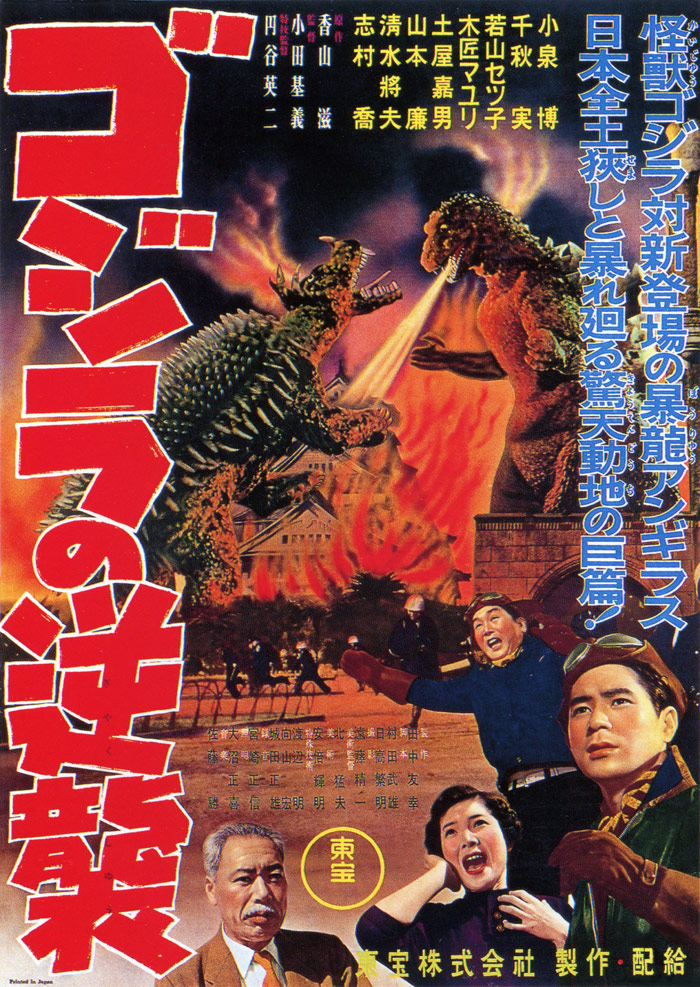
In Motoyoshi Oda’s sequel to Ishiro Honda’s ‘Gojira’ (1954), a new Godzilla arises to challenge Japan. However, Godzilla is not the only kaiju to appear; the spiked quadruped, Anguirus, emerges to challenge the King of the Monsters, in the first of the Godzilla series’ many colossal duels. There is lot to admire in this underrated instalment, even if lacks some of the finesse of its predecessor.
Following the destruction of the first Godzilla at the hands of Dr. Serizawa’s Oxygen Destroyer, a year of peace passes for Japan. One day two pilots, Shoichi Tsukioka (Hiroshi Koizumi) and Kojikawa Kobayashi (Minoru Chiaki), are out flying, scouting for fish. Kobayashi’s plane develops a fault, forcing an emergency landing on Iwato Island. Hidemi Yajima (Setsuko Wakayama), Tsukioka’s lover and daughter of the company president, radios Tsukioka to inform him of Kobayashi’s situation. Upon finding Kobayashi at Iwato, Tsukioka and Kobayashi rest a little; suddenly a familiar roar thunders across the island. The two spy Godzilla engaged in battle with another monster. Nearing cliffs, the two behemoths plunge into the Pacific Ocean.
Tsukioka and Kobayashi rush back to their home city of Osaka where they inform the authorities of their discovery. An emergency committee is convened, comprised of the JSDF, the police, scientists and government officials, with Tsukioka and Kobayashi present. At the committee the second monster is identified as Anguirus, based on a palaeontological study. In attendance is Dr. Kyohei Yamane (the brilliant Takashi Shimura); Yamane postulates that the first Godzilla that appeared in 1954 was not the only monster to be awakened by H-bomb tests; both the second Godzilla and Anguirus confirm this, and his fears voiced at the end of ‘Gojira’. With the means to destroy Godzilla lost due to the death of Serizawa who destroyed his Oxygen Destroyer notes, Yamane states that Godzilla becomes enraged upon seeing light, which reminds him of the H-bomb’s flash; he proposes a city wide blackout from which the military can use flares to lure Godzilla away from Osaka. With this knowledge Tsukioka, Hidemi, Kobayashi and the rest of Osaka fortify themselves against the incoming double storm of Godzilla and Anguirus.
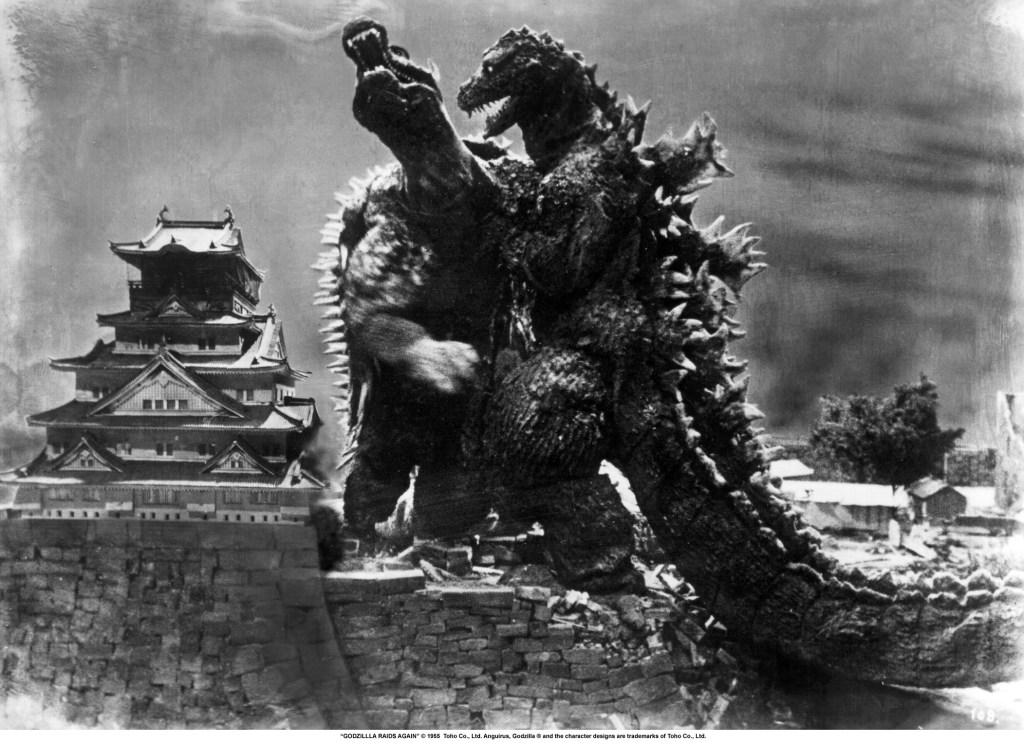
‘Godzilla Raids Again’ is an interesting instalment in the Godzilla series. As Godzilla sequels go, what is immediately striking is the visual style and tone; ‘Godzilla Raids Again’ retains the docudrama and expressionistic aesthetic of ‘Gojira’. This visual style would be dropped in favour of widescreen vistas in later films, starting from ‘King Kong vs. Godzilla’ (1962). The scenes of Osaka being torn apart as Godzilla and Anguirus rage against each other equal Godzilla’s attacks on Tokyo from the first film. Furthermore, the scars of World War II are reaffirmed. Could Godzilla and Anguirus, two creatures awakened by the bomb and waging mass death and destruction on a Japanese city, be symbolic of Hiroshima’s Little Boy and Nagasaki’s Fat Man? One key departure from ‘Gojira’ is the nature of the premise; where ‘Gojira’ played more like an apocalyptic disaster film, ‘Godzilla Raids Again’ is situated as war film. This is evidenced by the establishment of strategies and countermeasures against a known enemy; the use of aerial and naval reconnaissance by the JSDF and the Osaka blackout intensifies this state of a nation at war.
The sense of impending dread in the films first half is nicely executed; this atmosphere is underscored by the music by Masaru Sato (replacing Akira Ifukube). Sato’s score is very moody and menacing, helping reinforce the threat posed by Godzilla and Anguirus. The dissonance and minimalist tones work very well, even if it doesn’t have the gothic sturm und drang of Ifukube’s music. ‘Godzilla Raids Again’ marks the first of four scores that Sato would provide for the Godzilla series; however, Sato’s first score is markedly different from the later Godzilla scores he would compose for Jun Fukuda in the 60s and 70s. Returning for special effects duties is Eiji Tsuburaya, whose work maintains the high standard of ‘Gojira’. Both Godzilla and Anguirus look great; the second Godzilla is thinner than the first Godzilla. They are wonderfully vicious and feral looking, like enraged and wounded animals.This quality translates into their battles, which have a surprising violence and brutality to them. Serendipitously, when shooting the duel between Godzilla and Anguirus in Osaka, Tsuburaya accidently filmed at a lower frame rate (as opposed to the traditional high frame rate), resulting in a tactile and frantic engagement between the two kaiju.
The narrative pace may seem odd. It’s true that placing the final battle between Godzilla and Anguirus in the second act does mean the film loses some of its lustre in the second half. The battle with Anguirus is not the main purpose of the film. Rather it is about how Japan deals with the appearance of a second Godzilla; both its international title ‘Godzilla Raids Again’ and the Japanese title ‘Gojira no Gyakushū’ (which literally translates as ‘Godzilla’s Counterattack’) reaffirm the film as a war drama, with Godzilla striking back against Japan. After Godzilla defeats Anguirus and returns to the ocean, the film switches tack, focussing on the human characters rebuilding their livelihoods, with the drama transitioning north to Hokkaido. We spend a lot a time with characters from this point. While this is not bad in itself – Tsukioka, Kobayashi and Hidemi are likeable characters who are portrayed nicely by Hiroshi Koizumi, Minoru Chiaki and Setsuko Wakayama respectively – however, they lack the dynamism and depth that defined the human characters of ‘Gojira’. The writing is a little underdeveloped in this regard. However, the film does end strongly with an excellent climax between Godzilla and the JSDF on an icy archipelago.
‘Godzilla Raids Again’ is by no means a perfect film. However, it is a stronger film than its reputation suggests. It deserves credit for feeling like a natural successor to ‘Gojira’ in terms of visual style, tone and theme, even if it can’t top that film’s overall power and importance. Indeed, I would argue that ‘Godzilla Raids Again’s lesser status in the Godzilla canon is not helped by the fact that it situated in between two of the series most significant instalments; ‘Gojira’ and ‘King Kong vs. Godzilla’. Still ‘Godzilla Raids Again’ is worth a watch just to see cultural icon in the early stages of its development.

 M
M 