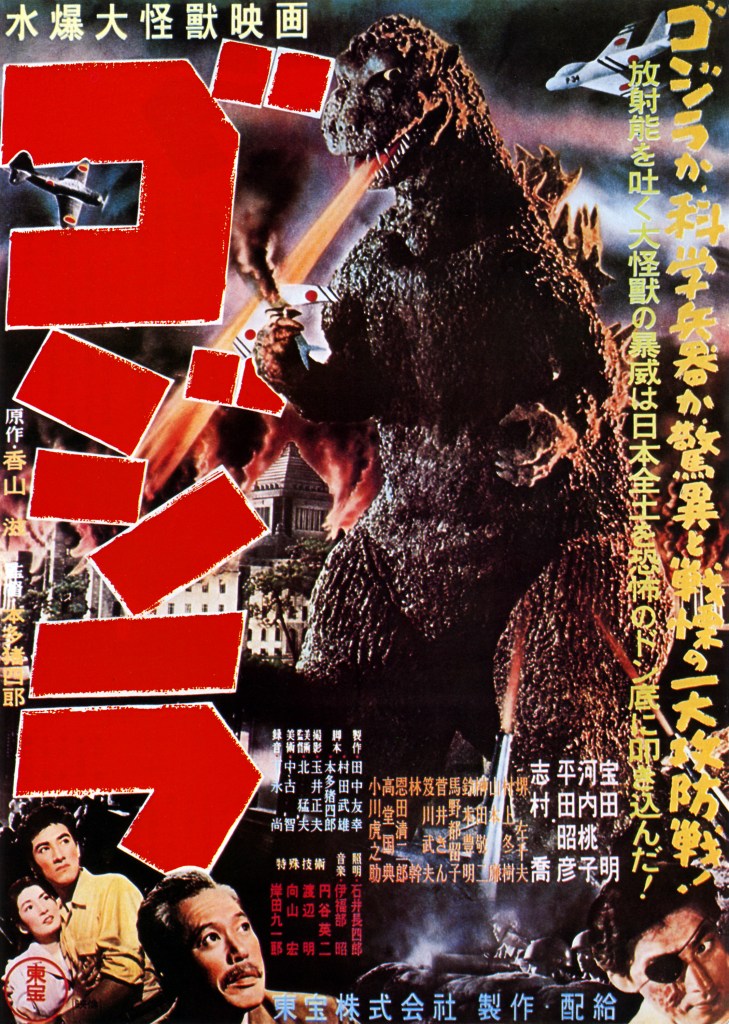
Ishiro Honda’s horror drama about a giant creature awakened and scared by atomic bomb tests in the Pacific Ocean who attacks Japan in anger, is a sobering and sincere call to reason from a nation coming to terms with its own wartime scars. A catharsis that brought into being one of cinema’s most prevailing icons; an origin that is in stark contrast to the high adventure and fantasy of its immediate successors.
The plot of ‘Gojira’ is effective and well measured. It starts with a Japanese fishing vessel sailing through calm waters. Suddenly a burst of light erupts beneath the waves. The crew run helplessly as the flaming ship is engulfed by the boiling seas. Similar incidents occur afterwards, leaving the authorities at a loss. A single survivor manages to reach the shores of Odo Island; his testimony that a giant monster caused the death and destruction of his colleagues is met with scepticism by the press. However, he is on borrowed time, when during the night a ‘freak storm’ hits the island and he and his house, among others, are crushed underfoot.
A research expedition to Odo, headed by Dr. Kyohei Yamane (the magnificent Takashi Shimura), is sent by the government to investigate. Joining Yamane are his daughter, Emiko (a graceful and dignified Momoko Kochi) and Hideo Ogata (a heroic and assertive Akira Takarada), a lieutenant in the Japan Coast Guard and Emiko’s lover. Upon reaching Odo they discover massive footprints containing high doses of radiation and trilobites. Yamane concludes that a prehistoric creature is cause of this destruction. He is proved right; a bell rings, and as he and the villagers race to a mountain top, the head of a large creature rises on the other side. The creature roars at the small trembling humans before him and then retreats to the sea.
Returning to the Japanese mainland, Yamane reports his findings to the government. Yamane states that the creature, christened ‘Godzilla’ in accordance with Odo folklore, is prehistoric. Furthermore, he claims that Godzilla is highly radioactive and that H-bomb tests in the Pacific Ocean are to blame for Godzilla’s appearance and anger. With this the government and the Japan Self-Defence Forces commence operations to destroy to Godzilla. This courts Godzilla’s wrath and the death and destruction mounts; Godzilla proves nigh indestructible. However, a colleague of Yamane and Emiko’s fiancé, Dr. Daisuke Serizawa (a haunting and brooding Akihiko Hirata), may hold the key to humanity’s salvation.
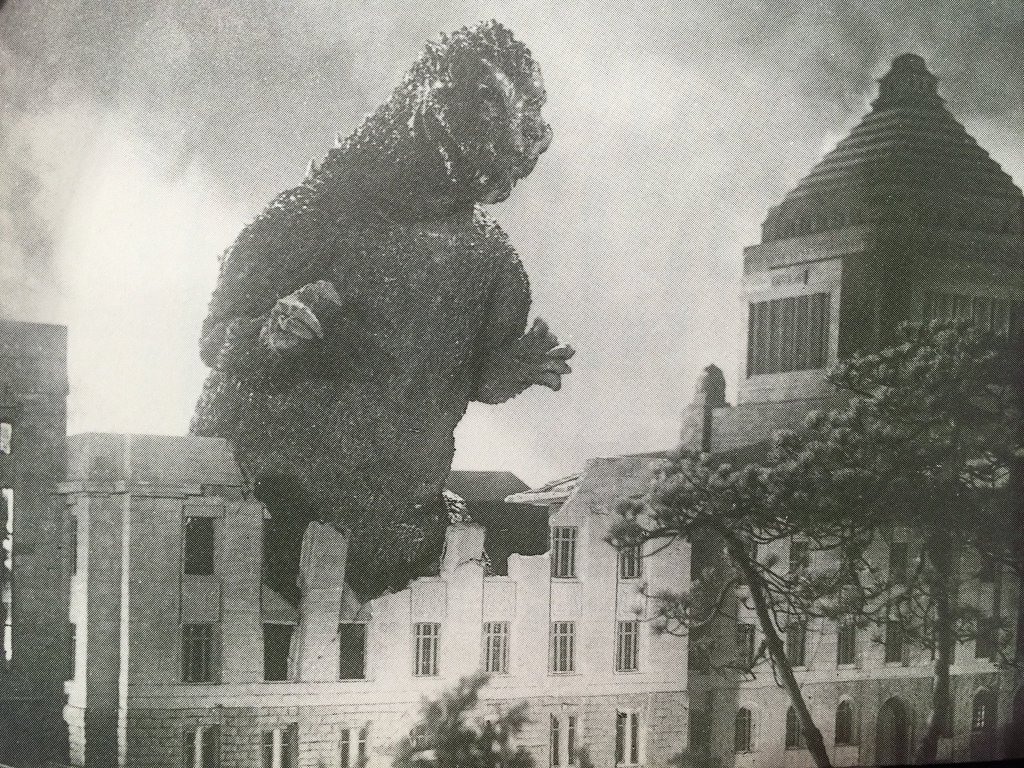
The are many reasons why Honda’s ‘Gojira’ remains a remarkable film. Chief among them is its sincerity and conviction; a belief buoyed by its producer Tomoyuki Tanaka. The film treats its central premise seriously, with the stakes having a real gravitas. Indeed, the film goes to great lengths to demonstrate the human cost of Godzilla’s actions. Actions in ‘Gojira’ have real consequences. What’s striking though is how the script, written by Honda, Takeo Murata and novelist Shigeru Kayama, gives equal precedence to both man and monster. While humans suffer at Godzilla’s hand, Godzilla equally suffers because man dared to play god with A-bombs and H-bombs. Godzilla’s actions against humanity are justified, not merely because of the injustices committed against the natural order but also being an unwitting victim of the H-bomb. Indeed as Yamane wisely puts it “Godzilla was baptised in the fires of the H-bomb and survived”. Like Japan in the aftermath of Hiroshima and Nagasaki, Godzilla is caught in a maelstrom of violence, anger, disbelief and sadness. Godzilla’s pain and the pain he brings is necessary to making sense of the reality that the characters inhabit. Take, for example, Godzilla’s second night time raid on Tokyo and its aftermath. As Godzilla rampages through Tokyo, destroying buildings and military opposition with ease, the film cuts to images of civilians, emergency responders and soldiers either fleeing destruction or resigned to their fate. There is a particularly heartbreaking moment during Godzilla’s rampage; a mother and her children are cowering by a building engulfed in flames, caused by Godzilla’s atomic breath. Cradling her children, as the fiery debris blocks any escape, the mother tells them they will be with their father. Further scenes of terror occur afterwards; a tense incident involves a journalist and cameraman reporting on Godzilla’s rampage. As Godzilla gets ever closer to them, the reporters, with sweat upon their faces, bravely continue their job as Godzilla bites down upon them and destroys the structure they’re on. Godzilla’s attack on Tokyo goes beyond natural disaster and enters the theatre of war, and the spectre of the Second World War looms large in the images, narrative and subtext of ‘Gojira’.
This sense of pain and destruction in Honda’s drama, is augmented by the excellent work of special effects director Eiji Tsuburaya and composer Akira Ifukube, whose score adds both an air of dread and militaristic might. Tsuburaya’s effects work holds up well even today.
I can’t recommend this film highly enough. All I can say is, do watch it!

 M
M 